


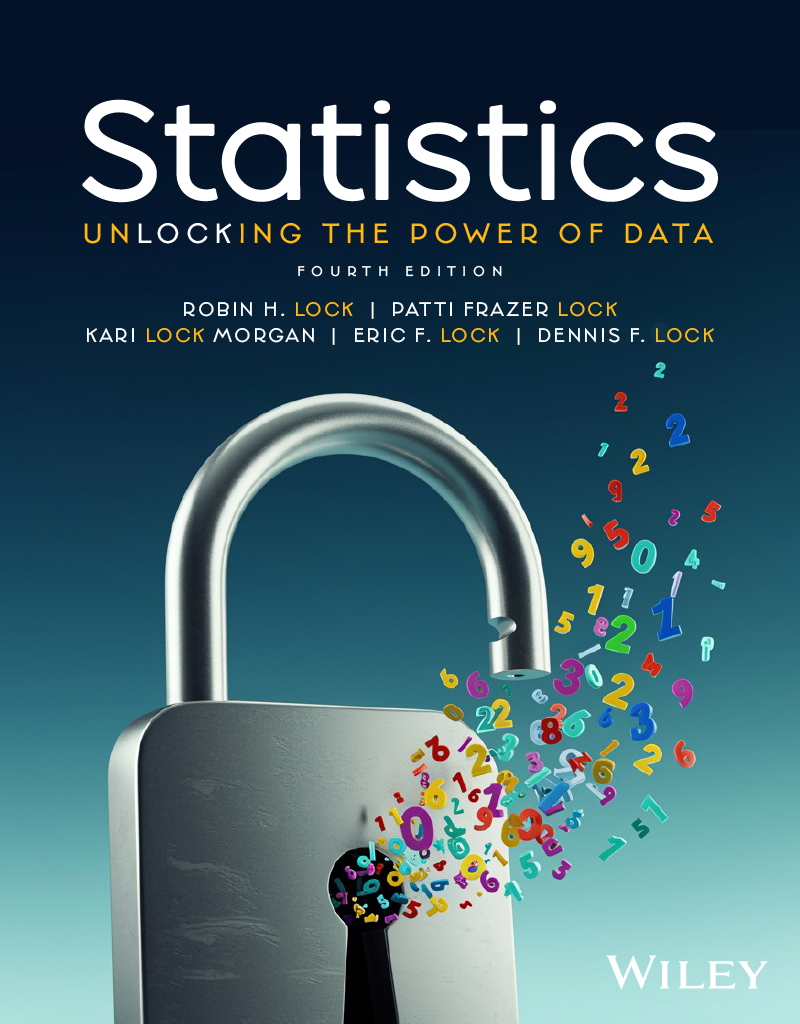
Statistics: Unlocking the Power of Data, 4th Edition
By Robin H. Lock, Patti Frazer Lock, Kari Lock Morgan, Eric F. Lock, and Dennis F. Lock
Statistics: Unlocking the Power of Data, 4th Edition, Digital Update, with corequisite support content, is designed for an introductory statistics course focusing data analysis using real-world data and applications. Students use simulation methods to effectively collect, analyze, and interpret data to draw conclusions. Randomization and bootstrap interval methods introduce the fundamentals of statistical inference, bringing concepts to life through authentically relevant examples. More traditional methods like t-tests, chi-square tests, etc. are introduced after students have developed a strong intuitive understanding of inference through randomization methods. While any popular statistical software package may be used, the authors have created StatKey to perform simulations using data sets and examples from the text. A variety of videos, activities, and a modular chapter on probability are adaptable to many classroom formats and approaches. The 4th edition WileyPLUS course includes 400+ new and revised problems, updated videos, and reviewed Adaptive Practice to align with the content updates made in the text.
Schedule a Demo Request Instructor AccountWant to learn more about WileyPLUS? Click Here
Lecture, Tutorial, and Example Walkthrough Videos
A comprehensive video set created exclusively by the author team includes chapter walkthroughs, videos to explain each learning objective in detail, and solution walkthroughs for every example throughout the text.
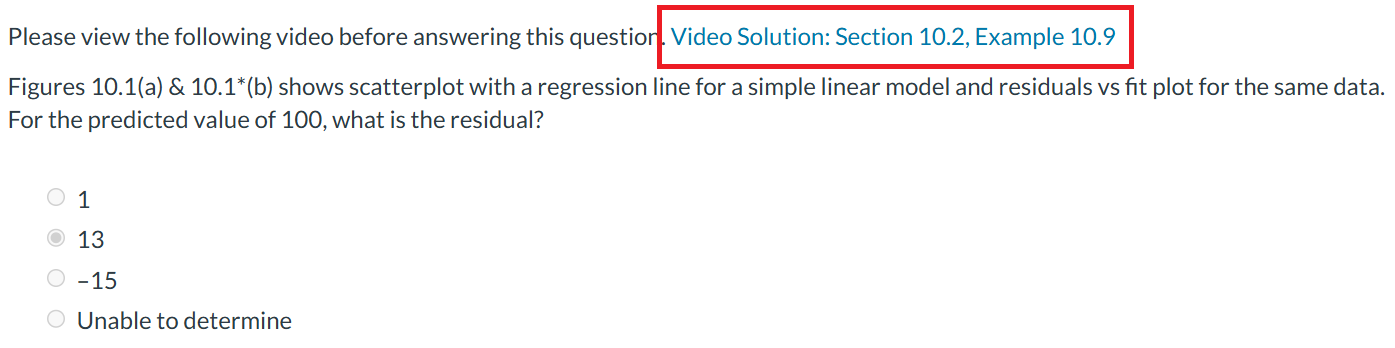
Video Questions
Homework questions feature a link to video solutions, or to video tutorials on the learning goal to give students full support as they work through each section.
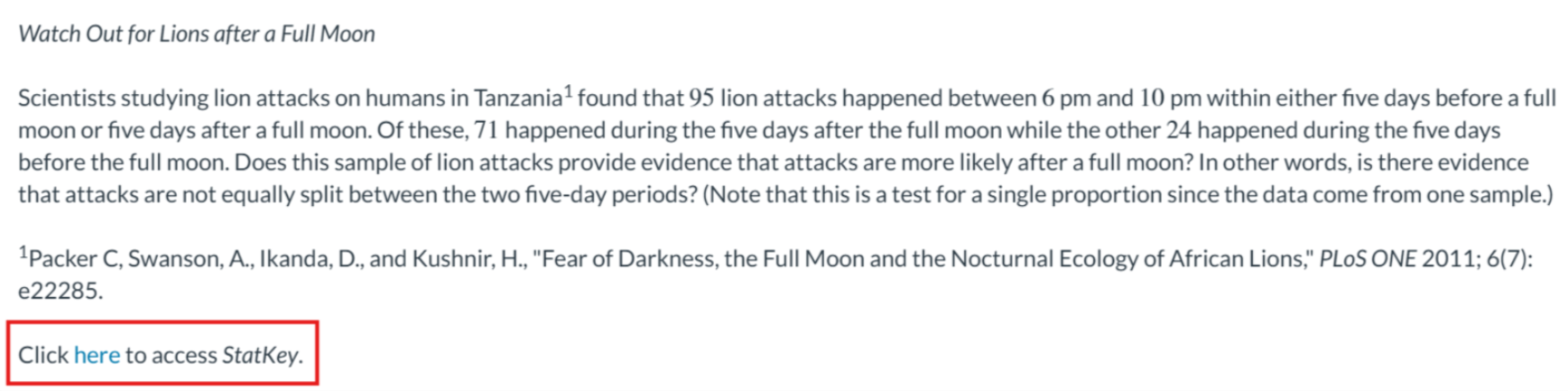
StatKey Integrated Problems
StatKey is integrated into problem statements to enhance students’ use of technology while solving problems.
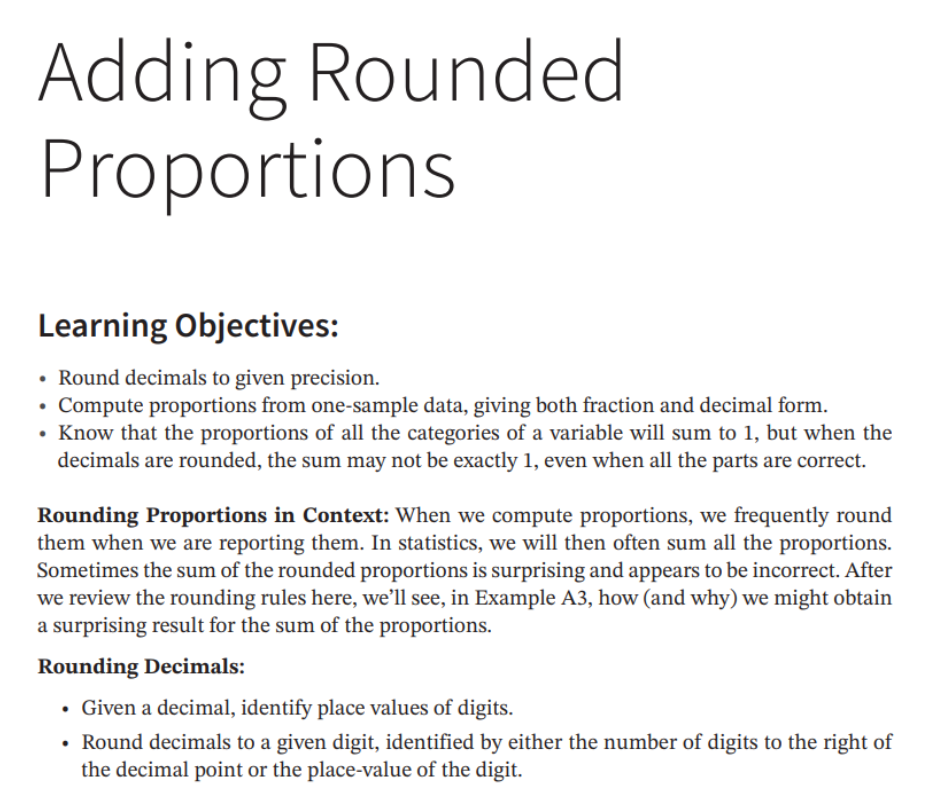
Corequisite Support Appendices
Available in WileyPLUS, this prerequisite review content includes topics specifically identified as helpful for success in an introductory statistics course and is presented with statistical context where appropriate to prepare students for the material ahead. Instructors will find a wealth of exercises to choose from for each topic, allowing them to pick and choose the right topics to support their corequisite model. Worksheets and assignable WileyPLUS questions are available for each prerequisite topic.
What’s New to This WileyPLUS Course
-
- 2025 GAISE Recommendations Alignment: The 4th edition WileyPLUS updates have been informed by the newly revised GAISE recommendations.
- 400+ New and Updated Problems: All revised real-world and technology-based problems from the 4th edition text will be available in WileyPLUS.
- Updated Author Videos: Videos will correspond with revisions to the 4th edition text.
- Updated Adaptive Practice: Adaptive assignments will align with changes made to the text, particularly the new content included in Chapter 2.
Additional Features Include
-
- StatKey features a set of statistical applets used to simulate and visualize data. It was developed by the author team and can be used with the data sets that come with the text, or by uploading your own favorite example. The StatKey data repository has been updated with new 4th edition data sets.
- StatKey features a set of statistical applets used to simulate and visualize data. It was developed by the author team and can be used with the data sets that come with the text, or by uploading your own favorite example. The StatKey data repository has been updated with new 4th edition data sets.
Instructor Resources
-
- Instructor’s Manual
- TestGen Computerized Test Bank
- Instructor’s Solutions Manual
- PowerPoint Lecture Slides
- Clicker Questions
- Class Activity Handouts
- Computerized Test Bank
- Printed Test Bank
- Software Manuals
- Projects
- Chapter Summaries
- 3e to 4e Problem Correlation Guide
- WileyPLUS Question Index
- Data Set Descriptive Guide
- Instructor Video Index
- Applications Index

Patti Frazer Lock is Professor of Mathematics at St. Lawrence University. She chaired the MAA subcommittee to write guidelines for the future of Intro Stats courses and is currently a co-chair of the ASA’s committee to revise the GAISE (Guidelines for Assessment and Instruction in Statistics Education) report on statistics education. She won the J. Calvin Keene faculty award at St. Lawrence University and the MAA Seaway Section’s Award for Excellence in Teaching. She is a member of the Calculus Consortium and is a co-author on Hughes-Hallett’s Calculus and Applied Calculus, Connally’s Functions Modeling Change, and McCallum’s Algebra and Multivariable Calculus texts. She is passionate about helping students succeed in, and enjoy, introductory courses in statistics and mathematics.

Robin H. Lock is Professor of Statistics in the Department of Mathematics, Computer Science, and Statistics at St. Lawrence University. He is a Fellow of the American Statistical Association, past Chair of the Joint MAA-ASA Committee on Teaching Statistics, a member of the committee that developed GAISE (Guidelines for Assessment and Instruction in Statistics Education), and a member of the Consortium for the Advancement of Undergraduate Statistics Education, CAUSE. His work was recognized with the ASA’s inaugural Waller Distinguished Teaching Career Award in 2014 and he has won numerous other awards for presentations on statistics education at national conferences. He brings to the project an insider’s understanding of national trends in statistics education.

Kari Lock Morgan got her Ph. D. in Statistics at Harvard University and has since taught statistics at Duke University and Penn State University. She has taught a variety of statistics classes, including a special course for graduate students on “The Art and Practice of Teaching Statistics”, and helped co-develop a new 100-level course at Harvard designed to make statistics enjoyable and applicable to real life. She has won multiple national awards for teaching statistics, including the ASA’s Waller Education Award for “innovation in the instruction of elementary statistics,” and the MAA’s Robert V. Hogg Award for “excellence in teaching introductory statistics.” She has particular interests in causal inference, statistics education, and applications of statistics in psychology, education, and health, but is currently taking a hiatus from those activities to enjoy raising her five children.

Eric F. Lock is an Associate Professor of Biostatistics at the University of Minnesota School of Public Health. He received his Ph.D in Statistics from the University of North Carolina in 2012 and spent two years doing a post doc in statistical genetics at Duke University. He taught multiple introductory statistics courses, ranging from very traditional to more progressive, during his time at UNC and Duke, and currently teaches a graduate course in Bayesian Statistics. He has a particular interest in machine learning and the analysis of high-dimensional data and is a PI on multiple NIH-funded projects on applications of statistics in genetics and medicine.

Dennis F. Lock joined the Buffalo Bills NFL team in 2019 and is now their Senior Director of Football Research and Strategy. He did similar analytics work for five years with the Miami Dolphins. He received his Ph.D. in Statistics from Iowa State University where he served as an instructor and statistical consultant. While an instructor at Iowa State he helped design and implement a randomized study to compare the effectiveness of randomization and traditional approaches to teaching introductory statistics.
Chapter 1: Collecting Data
1.1 The Structure of Data
1.2 Sampling from a Population
1.3 Experiments and Observational Studies
Chapter 2: Describing Data
2.1 Categorical Variables
2.2 One Quantitative Variable
2.3 One Quantitative Variable: Percentiles
2.4 Two Variable Relationships
2.5 Linear Regression
2.6 Data Visualization and Multiple Variables
Chapter 3: Confidence Intervals
3.1 Sampling Distributions
3.2 Understanding and Interpreting Confidence Intervals
3.3 Constructing Bootstrap Confidence Intervals
3.4 Bootstrap Confidence Intervals Using Percentiles
Chapter 4: Hypothesis Tests
4.1 Introducing Hypothesis Tests
4.2 Measuring Evidence with P-values
4.3 Determining Statistical Significance
4.4 A Closer Look at Testing
4.5 Making Connections
Chapter 5: Approximating with a Distribution
5.1 Hypothesis Tests Using Normal Distributions
5.2 Confidence Intervals Using Normal Distributions
Chapter 6: Inference for Means and Proportions
6.1 Inference for a Proportion
6.1-D Distribution of a Proportion
6.1-CI Confidence Interval for a Proportion
6.1-HT Hypothesis Test for a Proportion
6.2 Inference for a Mean
6.2-D Distribution of a Mean
6.2-CI Confidence Interval for a Mean
6.2-HT Hypothesis Test for a Mean
6.3 Inference for a Difference in Proportions
6.3-D Distribution of a Difference in Proportions
6.3-CI Confidence Interval for a Difference in Proportions
6.3-HT Hypothesis Test for a Difference in Proportions
6.4 Inference for a Difference in Means
6.4-D Distribution of a Difference in Means
6.4-CI Confidence Interval for a Difference in Means
6.4-HT Hypothesis Test for a Difference in Means
6.5 Paired Difference in Means
Chapter 7: Chi-Square Tests for Categorical Variables
7.1 Testing Goodness-of-Fit for a Single Categorical Variable
7.2 Testing for an Association between Two Categorical Variables
Chapter 8: ANOVA to Compare Means
8.1 Analysis of Variance
8.2 Pairwise Comparisons and Inference after ANOVA
Chapter 9: Inference for Regression
9.1 Inference for Slope and Correlation
9.2 ANOVA for Regression
9.3 Confidence and Prediction Intervals
Chapter 10: Multiple Regression
10.1 Multiple Predictors
10.2 Checking Conditions for a Regression Model
10.3 Using Multiple Regression
Chapter P: Probability Basics
P.1 Probability Rules
P.2 Tree Diagrams and Bayes’ Rule
P.3 Random Variables and Probability Functions
P.4 Binomial Probabilities
P.5 Density Curves and the Normal Distribution