


Elementary Differential Equations and Boundary Value Problems, 13th Edition
By William E. Boyce, Richard C. DiPrima, and Douglas B. Meade
Elementary Differential Equations and Boundary Value Problems, 13th Edition is written from the viewpoint of the applied mathematician, whose interest in differential equations may sometimes be quite theoretical, sometimes intensely practical, and often somewhere in between. In this revision, author Douglas Meade has refined the text for clarity, with new learning outcomes and descriptive theorem names that help students stay oriented and build confidence as the mathematics grows in complexity. New Application Projects and expanded problem sets give instructors more ways to bring the content to life. Meade builds upon Boyce and DiPrima’s work to combine a sound and accurate (but not abstract) exposition of the elementary theory of differential equations with considerable material on methods of solution, analysis, and approximation that have proved useful in a wide variety of applications. The main prerequisite for engaging with the program is a working knowledge of calculus, gained from a normal two- or three-semester course sequence or its equivalent. Some familiarity with matrices will also be helpful in the chapters on systems of differential equations.
Schedule a Demo Request Instructor AccountWant to learn more about WileyPLUS? Click Here
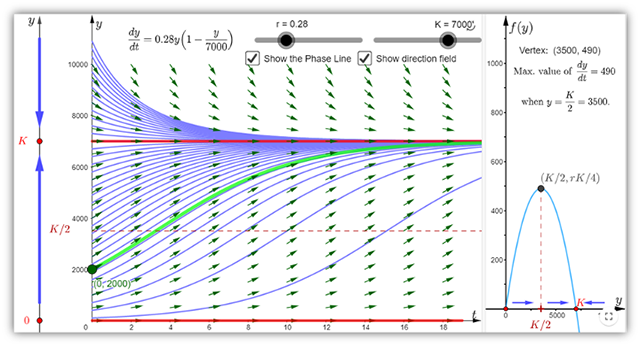
Interactive Figures
Interactive Figures have been created for many of the figures from the text, bringing concepts to life. These figures can be found in WileyPLUS and embedded within the e-text. Interactive figures are also utilized in WileyPLUS for evaluation on homework, quizzes, and tests.
Worked Examples Video Series
Worked example video series has been included in WileyPLUS to provide students with clear, accurate, and pedagogically sound videos all in one place.
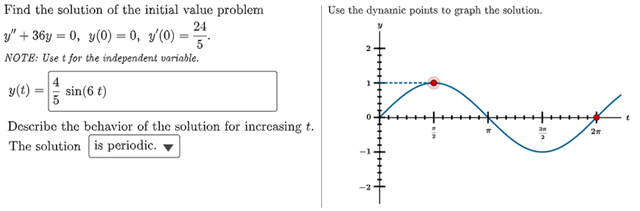
Interactive Questions
Symbolic math and graphing questions allow assignment of more complex auto-graded questions to enhance conceptual understanding.
Worksheets
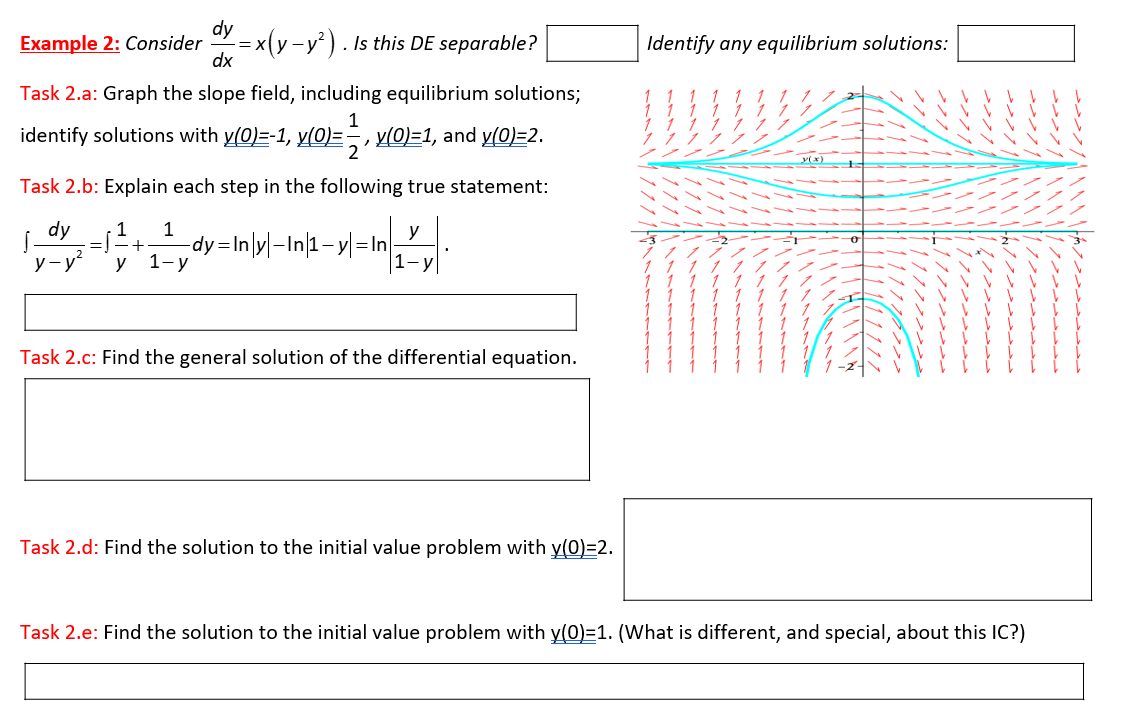
Worksheets have been developed as a lecture aid to teach class in a synchronous in-person, online or hybrid environment. Worksheets are designed to help students follow the presentation and discussion of topics in each section.
What’s New to This Course
- Application Problems now close each chapter. These explorations connect differential equations to real-world contexts, extend course content, and revisit classical problems from the history of the discipline. Application problems expand on topics like modeling the spread of contagious diseases. These problems can be used as special topics for in-class presentation and discussion, individual study assignments, or as a way to review and reinforce core concepts.
- Learning Outcomes have been added to every section and chapter to provide a clear framework for course planning. These learning outcomes are especially useful given the book’s modular structure, which supports a variety of course paths beyond the traditional linear sequence.
- Theorems now carry descriptive names alongside numeric references, making it easier for students to remember what each theorem says and how it connects to the broader content.
- Clarity and Usability Boxed elements like theorems, definitions, and examples have been updated to be self-contained, making them easier to use independently. More precise language throughout the text gives students consistent reminders about exactly what kind of object they’re working with at each step. These updates help students stay oriented as the content builds in complexity.
- Expanded Problem Sets include 300+ new or reinstated questions, giving students more opportunities to practice and instructors more flexibility to build assignments.
Additional Features Include
Instructor Resources-
- Instructor’s Solutions Manual
- Lecture Note PowerPoints
- Chapter Review Sheets
- Maple Technology Resources
- MATLAB Technology Resources
- Mathematica Technology Resources
- Projects
- WileyPLUS Question Index
- Interactive Figures
- Printed Test Bank
- TestGen Computerized Test Bank
-
- Chapter Review Sheets
- Interactive Figures
- Student Solutions Manual
- Maple Technology Resources
- MATLAB Technology Resources
- Mathematica Technology Resources
- Projects
Dedications In memory of William Boyce and Richard DiPrima. Two men whose passion for differential equations was instrumental in the shaping of my career. I am forever grateful.

WILLIAM E. BOYCE (deceased) received his B.A. degree in Mathematics from Rhodes College and his M.S. and Ph.D. degrees in Mathematics from Carnegie Mellon University. He was a member of the American Mathematical Society, the Mathematical Association of America, and the Society for Industrial and Applied Mathematics. He was also the Edward P. Hamilton Distinguished Professor Emeritus of Science Education (Department of Mathematical Sciences) at Rensselaer. He authored numerous technical papers in boundary value problems and random differential equations and their applications, as well as several textbooks including two differential equations texts, and was the coauthor (with M.H. Holmes, J.G. Ecker, and W.L. Siegmann) of a text on using Maple to explore Calculus. He was also coauthor (with R.L. Borrelli and C.S. Coleman) of Differential Equations Laboratory Workbook (Wiley 1992), which received the EDUCOM Best Mathematics Curricular Innovation Award in 1993. Professor Boyce was a member of the NSF-sponsored CODEE (Consortium for Ordinary Differential Equations Experiments) that led to the widely acclaimed ODE Architect. He was active in curriculum innovation and reform. Among other things, he was the initiator of the Computers in Calculus project at Rensselaer, partially supported by the NSF. In 1991, he received the William H. Wiley Distinguished Faculty Award given by Rensselaer. Professor Boyce passed away on November 4, 2019.
RICHARD C. DIPRIMA (deceased) received his B.S., M.S., and Ph.D. degrees in Mathematics from Carnegie-Mellon University. He joined the faculty of Rensselaer Polytechnic Institute after holding research positions at MIT, Harvard, and Hughes Aircraft. He held the Eliza Ricketts Foundation Professorship of Mathematics at Rensselaer, was a fellow of the American Society of Mechanical Engineers, the American Academy of Mechanics, and the American Physical Society. He was also a member of the American Mathematical Society, the Mathematical Association of America, and the Society for Industrial and Applied Mathematics. He served as the Chairman of the Department of Mathematical Sciences at Rensselaer, as President of the Society for Industrial and Applied Mathematics, and as Chairman of the Executive Committee of the Applied Mechanics Division of ASME. In 1980, he was the recipient of the William H. Wiley Distinguished Faculty Award given by Rensselaer. He received Fulbright fellowships in 1964-65 and 1983 and a Guggenheim fellowship in 1982-83. He was the author of numerous technical papers in hydrodynamic stability and lubrication theory and two texts on differential equations and boundary value problems. Professor DiPrima passed away on September 10, 1984.

DOUGLAS B. MEADE received B.S. degrees in Mathematics and Computer Science from Bowling Green State University, an M.S. in Applied Mathematics from Carnegie Mellon University, and a Ph.D. in mathematics from Carnegie Mellon University. After a two-year stint at Purdue University, he joined the mathematics faculty at the University of South Carolina, where he is currently an Associate Professor of mathematics. He is a member of the American Mathematical Society, Mathematics Association of America, and Society for Industrial and Applied Mathematics; in 2016 he was named an ICTCM Fellow at the International Conference on Technology in Collegiate Mathematics (ICTCM). His primary research interests are in the numerical solution of partial differential equations arising from wave propagation problems in unbounded domains and from population models for infectious diseases. He is also well-known for his educational uses of computer algebra systems, particularly Maple. These include Getting Started with Maple (with M. May, C-K. Cheung, and G. E. Keough, Wiley, 2009, ISBN 978-0- 470-45554-8), Engineer’s Toolkit: Maple for Engineers (with E. Bourkoff, Addison-Wesley, 1998, ISBN 0-8053-6445-5), and numerous Maple supplements for numerous calculus, linear algebra, and differential equations textbooks – including previous editions of this book. He was a member of the MathDL New Collections Working Group for Single Variable Calculus and chaired the Working Groups for Differential Equations and Linear Algebra.
1. Introduction 1.1 Some Basic Mathematical Models; Direction Fields 1.2 Solutions of Some Differential Equations 1.3 Classification of Differential Equations 2. First-Order Differential Equations 2.1 Linear Differential Equations; Method of Integrating Factors 2.2 Separable Differential Equations 2.3 Modeling with First-Order Differential Equations 2.4 Differences Between Linear and Nonlinear Differential Equations 2.5 Autonomous Differential Equations and Population Dynamics 2.6 Exact Differential Equations and Integrating Factors 2.7 Numerical Approximations: Euler’s Method 2.8 The Existence and Uniqueness Theorem 2.9 First-Order Difference Equations 3. Second-Order Linear Differential Equations 3.1 Homogeneous Differential Equations with Constant Coefficients 3.2 Solutions of Linear Homogeneous Equations; the Wronskian 3.3 Complex Roots of the Characteristic Equation 3.4 Repeated Roots; Reduction of Order 3.5 Nonhomogeneous Equations; Method of Undetermined Coefficients 3.6 Variation of Parameters 3.7 Mechanical and Electrical Vibrations 3.8 Forced Periodic Vibrations 4. Higher-Order Linear Equations 4.1 General Theory of nth Order Linear Equations 4.2 Homogeneous Differential Equations with Constant Coefficients 4.3 The Method of Undetermined Coefficients 4.4 The Method of Variation of Parameters 5. Series Solutions of Second-Order Linear Equations 5.1 Review of Power Series 5.2 Series Solutions Near an Ordinary Point, Part I 5.3 Series Solutions Near an Ordinary Point, Part I 5.4 Euler Equations; Regular Singular Points 5.5 Series Solutions Near a Regular Singular Point, Part I 5.6 Series Solutions Near a Regular Singular Point, Part II 5.7 Bessel’s Equation 6. The Laplace Transform 6.1 Definition of the Laplace Transform 6.2 Solution of Initial Value Problems 6.3 Step Functions 6.4 Differential Equations with Discontinuous Forcing Functions 6.5 Impulse Functions 6.6 The Convolution Integral 7. Systems of First-Order Linear Equations 7.1 Introduction 7.2 Matrices 7.3 Systems of Linear Algebraic Equations; Linear Independence, Eigenvalues, Eigenvectors 7.4 Basic Theory of Systems of First-Order Linear Equations 7.5 Homogeneous Linear Systems with Constant Coefficients 7.6 Complex-Valued Eigenvalues 7.7 Fundamental Matrices 7.8 Repeated Eigenvalues 7.9 Nonhomogeneous Linear Systems 8. Numerical Methods 8.1 The Euler or Tangent Line Method 8.2 Improvements on the Euler Method 8.3 The Runge-Kutta Method 8.4 Multistep Methods 8.5 Systems of First-Order Equations 8.6 More on Errors; Stability 9. Nonlinear Differential Equations and Stability 9.1 The Phase Plane: Linear Systems 9.2 Autonomous Systems and Stability 9.3 Locally Linear Systems 9.4 Competing Species 9.5 Predator–Prey Equations 9.6 Liapunov’s Second Method 9.7 Periodic Solutions and Limit Cycles 9.8 Chaos and Strange Attractors: The Lorenz Equations 10. Partial Differential Equations and Fourier Series 10.1 Two–Point boundary value Problems 10.2 Fourier Series 10.3 The Fourier Convergence Theorem 10.4 Even and Odd Functions 10.5 Separation of Variables; Heat Conduction in a Rod 10.6 Other Heat Conduction Problems 10.7 The Wave Equation: Vibrations of an Elastic String 10.8 Laplace’s Equation 11. Boundary Value Problems and Sturm-Liouville Theory 11.1 The Occurrence of Two-Point Boundary Value Problems 11.2 Sturm-Liouville Boundary Value Problems 11.3 Nonhomogeneous Boundary Value Problems 11.4 Singular Sturm-Liouville Problems 11.5 Further Remarks on the Method of Separation of Variables: A Bessel Series Expansion 11.6 Series of Orthogonal Functions: Mean Convergence