


Auditing: A Practical Approach with Data Analytics, 3rd Edition
By Raymond Johnson and Laura Wiley
The auditing profession is evolving faster than ever. AI, emerging technologies, and an increasingly complex regulatory landscape are reshaping what it means to be an auditor, and what employers expect from new graduates. Auditing: A Practical Approach with Data Analytics, 3rd Edition prepares students to meet these demands head-on, with fully updated content that reflects the realities of modern audit practice.
This edition has been extensively updated to ensure students are learning the standards, technologies, and skills they’ll actually use on the job. Every major auditing standard has been updated, and a dedicated focus on AI and emerging technologies, including how firms are using these tools today and why professional judgment remains essential, is woven throughout the text and supporting resources. Improved structure, clarity, and visual aids make complex concepts more accessible, while comprehensive, scaffolded problem material gives instructors the flexibility to challenge students at both the application and analysis level.
Within WileyPLUS, a rich set of learning resources is available to help bridge the gap between classroom concepts and real-world practice. With an emphasis on case-based learning and hands-on data analysis applications, Auditing develops the professional judgment and critical thinking skills needed to be successful in industry today.
Schedule a Demo Request Instructor AccountWant to learn more about WileyPLUS? Click Here
Resources to support student understanding
- Adaptive Assignments help close potential knowledge gaps through practice, just-in-time instruction, and remediation to prerequisite topics for struggling students.
- Topic Review Videos summarize key concepts for some of the most challenging topics in the text.
- Before you go on Interactive concept check questions are integrated after each learning objective in the e-text, providing practice at the point of learning.
Real world applications that drive relevancy
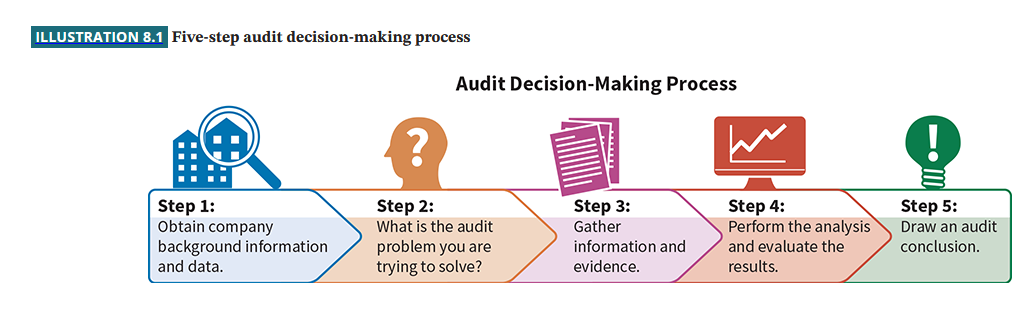
- Each chapter concludes with an Audit Decision Making Example that takes students through the steps of the audit process relevant to that chapter. These exercises teach students how to identify an audit issue, gather information and evidence, analyze and evaluate alternatives, and draw conclusions.
- Case based learning through chapter level Audit Decision Cases, and the Cloud 9 Continuing Case give students the opportunity to see how the concepts they have just learned can be applied within the context of a realistic business scenario.
Analytics skill development
- Data Analysis Technology Bootcamps help students develop foundational data analytics software skills in Excel, Power BI, Alteryx, SQL, and Tableau. Each bootcamp features video walkthroughs, auto-graded knowledge check questions, and application problems with video solutions.
- IDEA and Alteryx Cases give students additional practice applying course concepts within commonly used software.
What’s new in the text:
- Fully updated to meet all Auditing Standards and Regulations: This edition has been fully updated to meet all auditing standards, including alignment with AU-C 315 (SAS No. 145) on risk assessment and internal controls, updated independence rules with PCAOB Ethics guidance, new content on SAS No. 149 for group financial statement audits, and revised materiality guidance per AU-C 320.
- Integrated discussions on AI and Emerging Technologies: Chapter 8 has been expanded and renamed to “Audit Data Analytics and AI,” incorporating discussions of AI and the importance of professional judgement. Suggestions on how to utilize AI can be found in the end-of-chapter materials for select questions as well.
- Updated Content for Currency and Relevancy: Discussions of additional emerging technologies and the automation of key processes have been incorporated into the text. Real world examples have also been updated to ensure relevance.
- Updates to improve readability: The author has clarified wording, added headings, tables, and diagrams to ensure accuracy, currency, and clear understanding. New infographics and conceptual illustrations have also been added to help students visualize abstract concepts.
- Problem Material Updates: New end-of-chapter and test bank problems have been added to provide additional practice and assessment opportunities.
What’s new in WileyPLUS:
- New Power BI and Tableau Data Visualization Problems provide an out-of-the-box introduction to interpreting and analyzing visualizations.
- New AI Activities, with suggestions on how to incorporate AI into the classroom and into specific topics, have been added to Instructor’s Manual for select chapters.

Raymond N. Johnson, PhD, CPA, has taught auditing concepts and practices, financial statement analysis, and a case course focused on developing students’ critical-thinking skills at Portland State University for 35 years. He was the first recipient of Harry C. Visse Excellence in Teaching Fellowship and is currently a professor emeritus from Portland State University. He has also taught auditing and accounting at Bond University, The University of Queensland, the Australian National University, and Southampton University.
Dr. Johnson is a past Chair of the International Accounting Education Standards Board’s Consultative Advisory Group. Previously, he served on the NASBA board of directors for seven years, and he previously chaired NASBA’s Education Committee and the NASBA Ethics Committee. He also served on an AACSB Task Force that was responsible for the most recent update to AACSB Accounting Accreditation rules. Dr. Johnson served a three-year term on the AICPA Professional Ethics Executive Committee, which sets ethical standards for CPAs in the United States. He is a former member of NASBA’s Standard Setting Advisory Committee and served for seven years on the NASBA/AICPA International Qualifications Appraisal Board. Previously, Dr. Johnson served on the Oregon Board of Accountancy for seven years and was Chair of the Board for two years. Dr. Johnson is a past president of the Oregon Society of CPAs. He has previously served as staff to the U.S. Auditing Standards Board, has written numerous academic and professional articles, and has made numerous presentations at professional meetings.

Laura Wiley, PhD, CPA, is the Assistant Department Chair and distinguished instructor in the Department of Accounting at the E. J. Ourso College of Business, Louisiana State University (LSU). She also serves as Director of International Experience for the E. J. Ourso College of Business in which she leads study abroad excursions to Central and South America and Europe. She joined the faculty at LSU in 1996 and teaches financial accounting and auditing courses.
Dr. Wiley is active in the Society of Louisiana CPAs (LCPA), currently serving as a member at-large on the Board of Directors. She also served as the chair of the Accounting Education Issues committee from 2014 to 2023. In 2022, she was awarded the LSU Communication Across the Curriculum Outstanding Faculty Award. She also received the LSU Tiger Athletic Foundation Outstanding Instructor Award in 2019 and the LCPA’s Distinguished Achievement in Education award in 2015.
Dr. Wiley is co-author on Intermediate Accounting, 19th edition, also published by John Wiley & Sons. Dr. Wiley has consulted with large and small companies on accounting-related matters and conducted on-site training sessions for company employees. Over her career, she has also been a presenter at numerous CPE events and published in the Journal of Accounting Education. Prior to joining LSU, she was an auditor with PricewaterhouseCoopers in Atlanta, Georgia. She earned her bachelor’s degree in accounting from The University of Alabama, her master’s degree in accounting from LSU, and her doctorate in human resource education and workforce development from LSU. Her research interests are accounting education and financial literacy. She is an active licensed CPA in the state of Louisiana.
1. Introduction and Overview of Audit and Assurance 2. Professional Conduct and Legal Liability 3. Risk Assessment: Materiality, Professional Skepticism, and Audit Risk 4. Risk Assessment: Understanding the Client and Its Environment 5. Audit Evidence 6. Gaining an Understanding of the Client’s System of Internal Control 7. Risk Response: Performing Tests of Controls 8. Audit Data Analytics and AI 9. Risk Response: Performing Substantive Procedures 10. Risk Response: Audit Sampling for Substantive Procedures 11. Auditing the Revenue Process 12. Auditing the Purchasing and Payroll Processes 13. Auditing Cash, Inventory, and Related Income Statement Accounts 14. Auditing Investing and Financing Activities 15. Completing the Audit 16. Reporting on the Audit and Other Engagements Appendix 16A: Complete Examples of Auditor’s Reports Appendix A: Cloud 9 Inc. Audit