


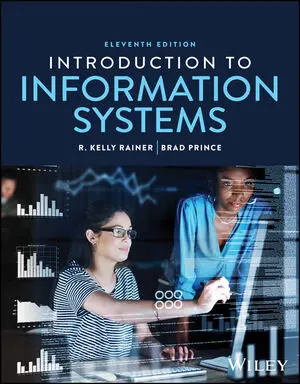
Introduction to Information Systems, 11th Edition
By R. Kelly Rainer and Brad Prince
Introduction to Information Systems, 11th Edition, with WileyPLUS helps students understand how information systems drive digital transformation and create value across all areas of business. Known for its active-learning pedagogy and real-world relevance, the text connects concepts to practice through opening and closing cases, IT’s About Business features, and updated coverage of AI, business analytics, cybersecurity, cloud computing, social media, and emerging technologies. helps students understand how information systems drive digital transformation and create value across all areas of business. Known for its active-learning pedagogy and real-world relevance, the text connects concepts to practice through opening and closing cases, IT’s About Business features, and updated coverage of AI, business analytics, cybersecurity, cloud computing, social media, and emerging technologies.
WileyPLUS enhances this foundation with a powerful suite of digital resources designed to build both conceptual understanding and career-ready skills. Together, the 11th Edition and WileyPLUS prepare students to analyze, apply, and leverage information systems to succeed in the digital economy.
Schedule a Demo Request Instructor AccountWant to learn more about WileyPLUS? Click Here
Adaptive Assignments ignite students’ confidence to persist so they can develop critical skills. By continuously adapting to each students’ needs and providing achievable goals with just-in-time instruction, Adaptive Assignments close knowledge gaps through scaffolded learning. Powered and refined by the Knewton Adaptive Engine, with more than 15 million users, this new assignment type gives instructors the flexibility and control to create targeted adaptive experiences that match their teaching preferences. With actionable analytics to support student and class intervention, Adaptive Assignments make teaching and learning more efficient than ever.
Ethics cases with discussion questions feature a variety of topics such as electronic monitoring and intellectual property rights to encourage students to think critically about how these topics are relevant to business and their own lives. Select cases are also available in video format in WileyPLUS to spark classroom debate and discussion.
Accounting Data Analysis Technology Bootcamps, available for Excel, Tableau, Power BI, Alteryx, and SQL, help students develop foundational data analytics software skills with Each bootcamp includes Overview Videos, How-To Videos, and Solution Walkthrough Videos to ensure students have the support they need to learn how to use the software and perform specific tasks, as well as assignable application exercises and data sets to help students demonstrate their understanding of the tool in a business context.

R. Kelly Rainer is the George Phillips Privett Professor in the Harbert College of Business at Auburn University. He earned his Ph.D. from the University of Georgia (1988). Rainer has published in MIS Quarterly, Journal of Management Information Systems, Communications of the ACM, and Decision Sciences as well as other leading journals. He is associate editor of the Information Resources Management Journal and associate editor of the Communications of the Association of Information Systems Journal.

Brad Prince is a professor of information systems at the University of West Georgia. He earned his Ph.D. from Auburn University (2006) where he was a student of R. Kelly Rainer’s. Prince has published in Review of Business Research, Review of Social Studies, Law and Psychology, European Journal of Information Systems, and Journal of Academy of Business and Economics, among others. He is a member of the Association of Information Systems and the Association of Computing Machinery.
Chapter 1: Introduction to Information Systems Chapter 2: Organizational Strategy, Competitive Advantage, and Information Systems Chapter 3: Ethics and Privacy Chapter 4: Information Security Chapter 5: Data and Knowledge Management Chapter 6: Telecommunications and Networking Chapter 7: E-Business and E-Commerce Chapter 8: Wireless, Mobile Computing, and Mobile Commerce Chapter 9: Social Computing Chapter 10: Information Systems within the Organization Chapter 11: Customer Relationship Management and Supply Chain Management Chapter 12: Business Analytics Chapter 13: Acquiring Information Systems and Applications Chapter 14: Artificial Intelligence Technology Guide 1: Hardware Technology Guide 2: Software Technology Guide 3: Cloud Computing Appendix: Apply the Concept Activities